
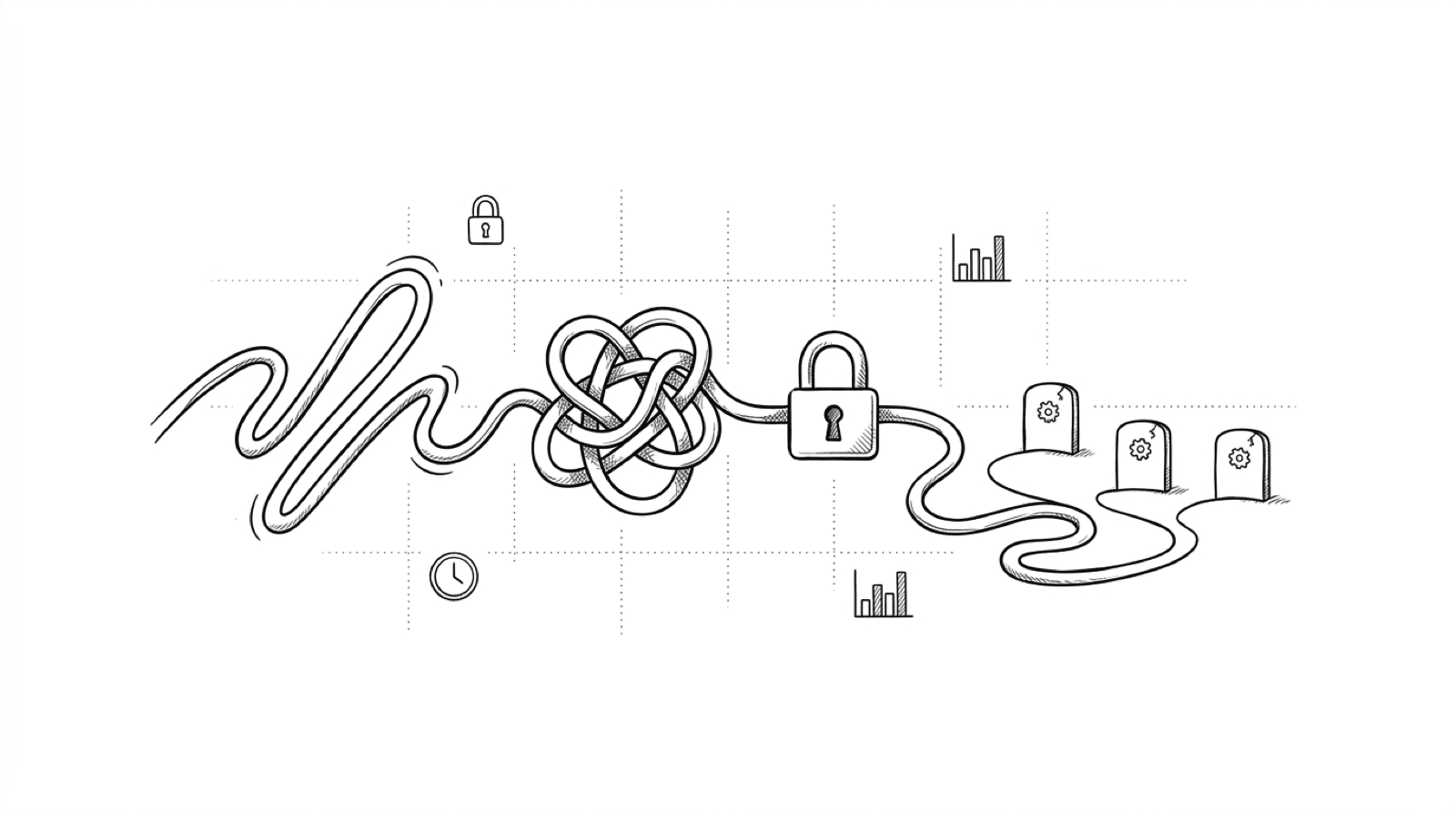
Where Social Media API Side Projects Go to Die
I have watched a specific kind of project die more times than I can count. Someone wires up the X API on a Saturday, hits a wall on Sunday, and by the following weekend the repository is archived with a commit message like “pausing this for now.” The wall is almost never the code. Posting to a social network is one HTTP request. What kills the project is everything wrapped around that request: metered pricing, a review queue with no published deadline, an audit that keeps your posts private until a stranger approves them, and a maintenance bill that starts the day after launch and never stops.
I run a company that eats this cost on behalf of other people’s software, so I read the fine print for a living. Below is what X, Meta and TikTok actually say today about their own pricing and review processes, pulled straight from their developer sites and dated, plus the part most comparison posts skip: what you give up when you hand this problem to someone else, including me.
Every unfinished scheduling side project follows the same three commits
Most abandoned social publishing projects share a shape: a working prototype against one platform, a second platform that needs its own OAuth app and its own review queue, and a silent stop once the maintainer hits a wall that has nothing to do with programming.
The first commit is always fast. You register an app, get a client ID, hit an endpoint, watch a post appear. That takes an afternoon on any platform. The second commit is where projects start dying: a second network with its own developer console, its own OAuth quirks, its own idea of what a “post” object should look like. The third commit, if the project survives that long, is the one nobody plans for. Three months later a token expires silently, or a platform emails you about a deprecated endpoint, and the tool you built to save time is now the thing eating your Saturday.
None of that shows up in a getting-started tutorial. It shows up in the social media API approval process: pricing, review, and audit, the three sections everyone skims past to get to the code sample. I read all three for X, Meta and TikTok this month, straight from their own documentation, because the numbers move often enough that anything older than a few months is a guess.
X charges per post now, and there is no free plan for new developers
As of X’s current API pricing documentation (accessed July 2026), X runs a pay-per-use model with no subscription: $0.015 per post you create, $0.20 if that post contains a link, and $0.005 per post you read, capped at 2 million reads a month before you need an Enterprise plan.
That is the entire pricing page today. No Free tier, no $200-a-month Basic sign-up button, nothing you can start on without a credit card attached. Likes, mutes and blocks read at $0.001 each, user lookups and direct messages both run $0.010, and creating a list costs $0.010 too. Go past the 2 million post-read cap in a month and the only path X states is Enterprise, priced individually and widely reported around $42,000 a month by trackers like Postproxy and xpoz.ai, a figure X itself does not publish on the pricing page.
X did run subscription tiers before this switch. Third-party trackers, including Postproxy and We Are Founders, report that legacy Basic ($200 a month) and Pro ($5,000 a month) plans still exist for developers who signed up early, but new developers cannot choose them anymore. Whatever the old tier structure, the number that matters for a side project starting today is the one on the current page: every post costs real money from the first one, and the meter never stops.
Meta reviews every permission on its own, with no published deadline
Instagram and Facebook posting permissions each require a separate App Review submission: a written use-case description, a screencast of the end-to-end flow in English, working login credentials for Meta’s reviewers, and proof of at least one successful API call, per Meta’s own Instagram Platform App Review documentation. Meta does not publish a turnaround time.
I checked developers.facebook.com’s Instagram Platform App Review page directly rather than trust a summary, because this is the page people build a launch date around. It confirms the mechanics: one submission per permission, a video walkthrough Meta can actually watch, with captions if your interface is not in English, and a note that reviewers need to log into your app and use it themselves. If they cannot access it, the whole submission gets rejected, not just the permission in question.
What the official page will not tell you is how long that takes. Write-ups from agencies that handle a high volume of these reviews, PostMoore and Phyllo among them, converge on a similar shape: roughly two to four weeks per round, sometimes longer for permissions Meta treats as higher-risk, and every rejection restarts the clock from zero. None of that is Meta’s own promise. It is the accumulated experience of people who submit apps often, and I trust it more than a vendor’s marketing page.
TikTok keeps your posts private until an audit clears you
TikTok’s own Content Posting API documentation states that content posted by an unaudited client is restricted to private viewing mode. To lift that, your API client has to pass an audit verifying compliance with TikTok’s terms of service, a separate step from getting API keys in the first place, and TikTok states plainly it gives no official review timeline.
This is the one that surprises people most, because it means your integration can be technically finished, tokens working, posts uploading, and still be invisible to anyone but you until a human at TikTok signs off. TikTok’s developer guidelines lay out what they want along the way: a functioning app they can log into on request, sandbox mode while you are still incomplete, verified ownership of your privacy policy and terms URLs, and ongoing compliance. A violation found later, even from a user complaint, can mean an immediate and permanent ban of the account and the business entity behind it.
On timeline, TikTok is the most candid of the three. Its own developer guidelines say it directly: it does not provide an official review timeline or any guarantees for approval, and response times vary because this is a manual process. Practitioner write-ups put a clean, well-documented first submission at roughly one to two weeks, but that is a field average from people who write about this professionally, not a number TikTok stands behind.
The three platforms, side by side, dated July 2026
| Platform | What posting costs to run | Review or audit required | Stated turnaround |
|---|---|---|---|
| X (Twitter) | $0.015 per post created, $0.20 with a link, metered, no free tier for new developers | No content review to start posting; Enterprise required past 2M reads a month | Not applicable, billing is instant once credits are loaded |
| Meta (Facebook / Instagram) | Free to call once approved | Separate App Review per permission: screencast, use case, live reviewer login | None published; developer reports commonly cite 2 to 4 weeks per round |
| TikTok | Free to call, but posts stay private until cleared | Audit of the API client itself, tied to Terms of Service compliance | None published; TikTok states directly it gives no official SLA |
Sources: X pricing from X’s own API pricing documentation. Meta from developers.facebook.com’s Instagram Platform App Review page. TikTok from developers.tiktok.com’s Content Posting API and developer guidelines pages. All accessed July 2026. The turnaround ranges outside X are third-party developer reports, not vendor guarantees. Treat them as a planning buffer, not a contract.
Passing review once is the easy year. Staying integrated is the job.
Getting approved is a one-time event with a deadline you can push through. Staying integrated is not: platforms deprecate endpoints on their own schedule, OAuth tokens expire and need refreshing before they silently fail, and every network carries quirks, character limits, media formats, thread structures, that drift without an announcement you will see in time.
This is the part a graveyard repository never reaches. Say you clear Meta’s review and TikTok’s audit in the same quarter. Congratulations, you now maintain two OAuth refresh flows, two rate-limit schemes, and two support inboxes for the day a user’s account randomly stops posting. Add X’s metered billing and you have a third bill to watch, because a bug that retries too aggressively is not just annoying anymore. It is an invoice.
Token expiry is the quiet killer. A long-lived token is not permanent, and platforms differ on how and when they revoke it: silently, on a password change, on a scope change, on plain inactivity. If nothing refreshes it before that happens, scheduled posts stop going out with no error a user actually sees, until someone checks the dashboard days later and asks why nothing has been posted all week. Most teams find this out from an angry customer, not from a monitoring alert, because they never built the alert.
One API key behind 30+ platforms is the boring answer, and it is correct
PostSider puts X, Meta, TikTok, LinkedIn and 30+ platforms behind one API key and one review process, ours instead of yours. A durable background workflow refreshes every connected account’s token on its own schedule, so a stale credential does not silently stop your posting. Webhooks retry automatically when your endpoint times out or errors, so a missed delivery is not a lost event. Rate limiting is per organization, and the limit comes back to you in the response headers instead of a surprise 429.
This is not a hypothetical pitch, it is the reason the product exists. I built the scheduling API walkthrough around this exact call: one POST /public/v1/posts, a type of schedule, a channel ID, and the platform difference collapses into a single settings field. Underneath that one call, a background workflow keeps every connected account’s token current, so you are not the one who finds out a refresh silently failed at 3am. Webhooks fire an X-Postsider-Signature header you verify and retry on their own if your handler times out, and the rate limit on the public API, 60 requests a minute per organization, arrives in the response instead of a guess.
None of that removes X’s metering, Meta’s review, or TikTok’s audit. It removes the part where you personally carry three separate versions of that burden, plus a fourth and a fifth as you add platforms. I went deeper on the full decision tree, native integration versus a pure developer API versus a scheduler with a real API behind it, in how to pick a social media scheduling API, if you want the fuller comparison.
What you actually give up by going aggregated, no spin
An aggregated API trades platform-specific depth for coverage. No vendor exposes X’s Ads API, TikTok’s Research API, LinkedIn’s full Marketing Developer Platform, or every native format, Spaces, Collabs, polls, Reels remix chains, through one generic post object. If your product needs those specifically, native integration is still the right call.
Say this plainly, because most comparison content skips it and it is the part that actually earns trust. X’s advertising API, its analytics firehose, and features like Spaces are not something any aggregator, mine included, wraps into a scheduling call. TikTok’s Research API for academic and safety use, and its deeper ad-account tooling, live outside the Content Posting API entirely. LinkedIn’s full Marketing Developer Platform, the one that enables lead-gen forms and matched audiences, needs its own partner application regardless of what scheduler sits in front of it. Instagram Collabs and platform-native poll types get supported once platforms ship stable public endpoints for them, not before, so an aggregator is always a step behind a platform’s newest feature by definition.
If your product’s core value is one of those edge capabilities, an aggregator will slow you down, not speed you up, because you end up working around a generic shape instead of the native one. The honest line I give people who ask me this directly: if social publishing is a feature of what you are building, not the product itself, one API key covering the common ground most teams need is the right trade. If a platform-specific capability is your product, go native and budget the review queues as the real cost they are.
None of the three platforms above are wrong to review and meter what runs against real accounts. Spam, scraping and abuse are exactly why the queues exist. But a side project does not have a compliance team, and a two-person startup does not have a spare month to wait on a reviewer’s queue. If you would rather spend that month building the thing your users actually asked for, the current plans, including what the API costs on each tier, are on the pricing page. Read the fine print once, mine included, and then go build.
Frequently asked questions
How long does Meta's app review take for Instagram or Facebook posting permissions?
Meta's own documentation does not publish a turnaround time. It only confirms the mechanics: a separate submission per permission, with a screencast, a use case description and working reviewer login access. Developer write-ups that handle a high volume of these reviews, including PostMoore and Phyllo, commonly report two to four weeks per round, and every rejection restarts that clock.
What does the X (Twitter) API cost in 2026?
X runs a metered, pay-per-use model with no free tier for new developers, according to X's own API pricing documentation. Creating a post costs $0.015, or $0.20 if it contains a link, and reading a post costs $0.005, capped at 2 million reads a month before you need an Enterprise plan.
Does TikTok require an app review before you can post through its API?
Yes. TikTok's Content Posting API restricts everything an unaudited client posts to private viewing mode, per TikTok's own documentation, until your API client passes an audit that verifies compliance with its terms of service. TikTok states directly that it gives no official review timeline.
What is the fastest way to publish to multiple social platforms without going through each platform's review process on your own?
You still cannot skip a platform's own review or audit entirely, someone has to pass it. What you can skip is doing it yourself for every network. An aggregated API like PostSider maintains its own approvals with X, Meta, TikTok and 30+ other platforms, so you connect an account and post through one API key instead of building and clearing N separate review processes.