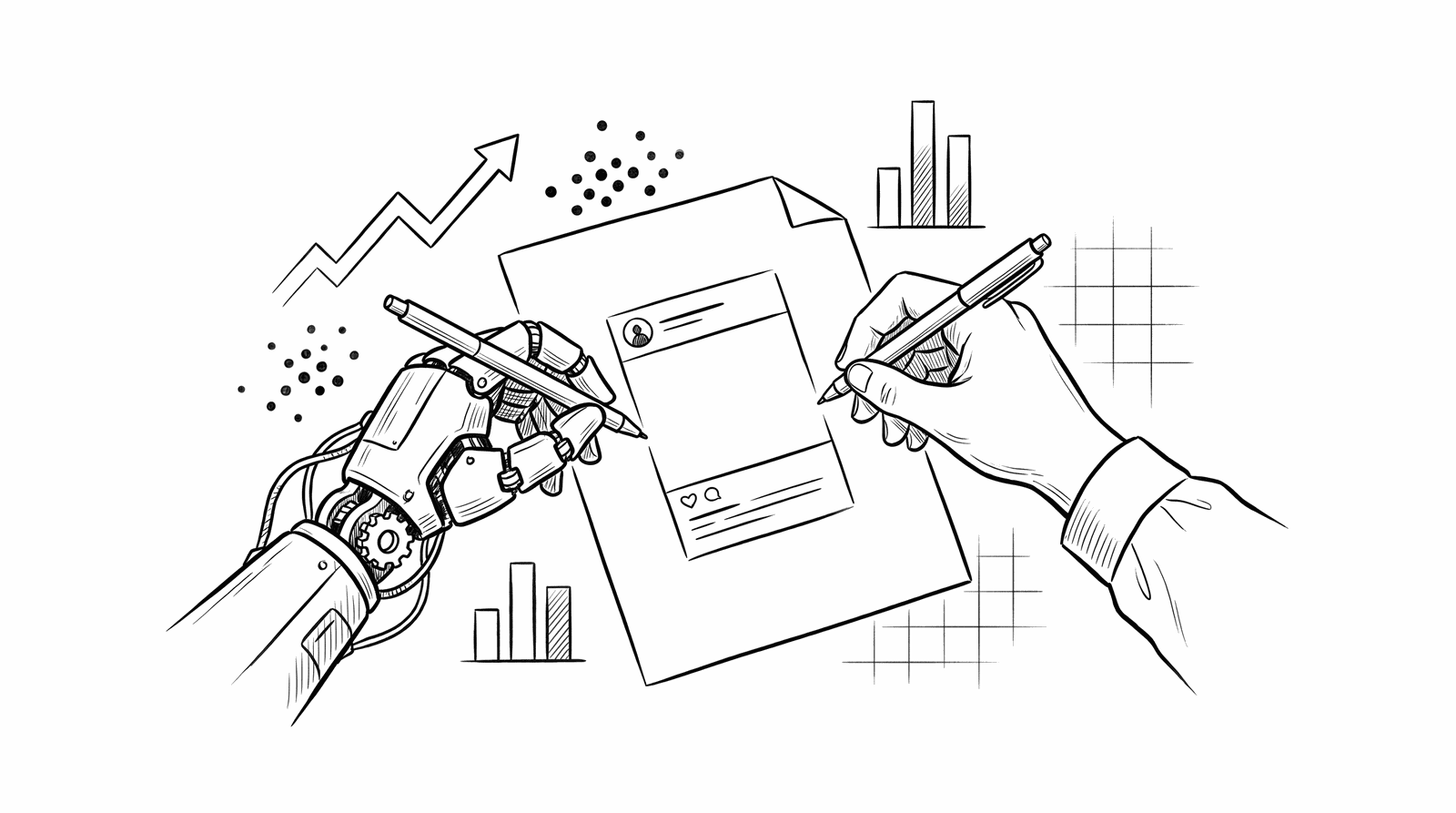
AI Content vs Human Content on Social in 2026
In the first quarter of 2026, 49.9 percent of articles published on the web were primarily AI-generated, essentially even with human writers, according to Graphite’s analysis run across three detectors. “Slop” was the 2025 Word of the Year at both Merriam-Webster and the American Dialect Society. And on social specifically, a wave of AI images and videos flooded the big feeds hard enough that platforms started pulling monetization to slow it down. So the honest starting point for any 2026 content plan is this: the feed you are posting into is now half machine, and everyone scrolling it knows.
That is the setup most “AI vs human” takes get wrong. They frame it as a fight where you pick a side. It is not. AI is the best drafting leverage anyone in social has ever had, and I use it every day. The mistake is confusing leverage with a finished product. This piece is about where that line actually sits, backed by real numbers, and why the winning move in 2026 is boring to say and hard to do: AI for speed, a human for the last mile. Every figure below is attributed to a named source. Where I could not verify one, I said so.
Half the internet is now AI-written, and the volume is not the interesting part
Primarily AI-generated articles crossed parity with human-written ones in late 2025 and have hovered there since. The interesting fact is not that AI writes a lot. It is that writing a lot no longer buys you anything.
Graphite tracked the share of primarily AI-generated articles from 49.6 percent in Q1 2025 to 50.9 percent in Q4 2025 (the quarter it edged past humans), settling at 49.9 percent in Q1 2026 (Graphite). They averaged three separate AI detectors, Pangram, Copyleaks, and GPTZero, and validated a false-positive rate below 2 percent against 15,700 articles published before ChatGPT existed. This is careful work, not a scare headline.
Here is the curve, which is the part worth sitting with.
Now the punchline. In the same study, Graphite found that these AI-generated articles, despite matching human output one for one, largely do not appear in Google or ChatGPT results. The volume went up. The visibility did not follow. That is the first crack in the “just automate it” theory. You can flood the internet with AI text and still be invisible, because the systems that decide what gets seen are getting better at ignoring the flood.
On social this shows up as demonetization. Meta pulled monetization from repetitive AI content and actioned hundreds of thousands of spam-linked accounts in 2025 (WebProNews summary). YouTube’s CEO named reducing slop a 2026 priority. The platforms are not neutral about this. They are actively down-ranking the exact thing an unsupervised AI content pipeline produces.
AI slop and AI-assisted content are opposites, not a spectrum
The single most useful distinction in this whole debate: AI slop is content published straight from the model with no human owning it. AI-assisted content is content where AI did the grunt work and a human owns the result. Same tool. Opposite outcome.
I want to be precise here because the industry keeps blurring it. “AI slop” got named the 2025 Word of the Year by Merriam-Webster for a reason. It describes a specific failure mode: high-volume, low-effort, generated content produced to game engagement, with no point of view and no editing. The shrimp Jesus images. The 900-word posts that say nothing. The comment that is technically on-topic and obviously written by a bot.
AI-assisted is a different practice entirely. Here is the split I actually use.
| AI slop | AI-assisted (done right) | |
|---|---|---|
| Who owns the final text | Nobody, it ships as generated | A human, always |
| Point of view | None, or generic consensus | A real opinion or lived detail |
| Facts and numbers | Unchecked, sometimes invented | Verified against a named source |
| AI tells (em-dashes, “delve”, rule-of-three) | Visible everywhere | Edited out |
| Volume vs quality | Maximize volume | Quality per post, AI removes the grind |
| Reach trend in 2026 | Down-ranked, demonetized | Rewarded, indistinguishable from hand-made |
The reason this matters is that the market keeps proving people cannot tell good AI-assisted work from human work, and that is fine. What they reject is slop, and what they punish is being deceived. Those are two separate failures and only one of them is about the tool.
If you want the mechanics of running AI at the draft stage without it leaking into the final voice, that is exactly what I built the blog-writer agent skill around. It drafts fast and then strips every AI artifact, no em-dashes, no smart quotes, no “unlock your potential”, so the output reads like a person wrote it. The skill exists because the last-mile edit is the hard part, and it is worth automating the checklist even if a human still makes the calls.
People love AI content right up until they know it is AI content
Blind, audiences often prefer AI writing. Told, they disengage from it. That gap is the entire trust problem in one sentence, and it is measured.
Bynder surveyed 2,000 consumers across the US and UK (Bynder’s AI vs human study). Two findings sit right next to each other and they look contradictory until you read them together. First, in a blind test, 56 percent of people who had a preference chose the AI-written article over the human one. Second, once they were told a piece was AI-generated, 52 percent said they became less engaged with it. Same content quality. The only variable that changed was disclosure, and disclosure cut engagement in half.
This lines up with everything else I found. Sprout Social reported 52 percent of social users are concerned about brands posting AI-generated content without disclosing it, and 55 percent said they are more likely to trust brands that publish human-generated content. Hootsuite’s Social Trends 2026 report put a sharper edge on it: more than 30 percent of consumers say they are less likely to choose a brand once they know its ads are AI-generated.
Read those together and the strategic conclusion is not “never use AI”. It is “never let the seams show, and never lie about it”. The penalty is not for using the tool. The penalty is for the audience noticing, which happens either because the work is sloppy or because a label tells them. Which brings us to the labels.
The platforms are removing your choice about disclosure
You will not get to decide whether your AI content is labeled. In 2026 the platforms increasingly decide for you, and the law is moving the same direction.
The shift, in one line: labeling went from “creators must disclose” to “we detect and label it whether you disclose or not”. Here is where the major platforms stood heading into 2026, per an influencer marketing platform comparison and AuditSocials’ cross-platform breakdown.
| Platform | AI-labeling posture (2025 to 2026) |
|---|---|
| TikTok | Adopted C2PA Content Credentials in January 2025, auto-labels detected AI, reportedly labeled over 1.3 billion AI videos, issues strikes for undisclosed synthetic media |
| Meta (FB/IG) | “AI info” label on detected content and on ads built with Meta’s generative tools, C2PA-based, demonetizes repetitive AI content |
| YouTube | Disclosure policy since 2024, auto-applies a label when it detects realistic synthetic content, named slop reduction a 2026 priority |
| Regulation | EU AI Act and California’s SB 942 push machine-readable AI labeling toward legal requirement |
Both TikTok figures trace to the platform’s own transparency reporting: it has labeled more than 1.3 billion AI-generated videos, and its Fifth Transparency Report logged 51,618 synthetic-media videos removed in the second half of 2025, up 340 percent year over year (TikTok Newsroom).
The practical takeaway is simple. If your plan depends on AI content passing as human because nobody labels it, that plan is already expiring. The label is coming from the platform’s detector, not from your honesty. So the only durable strategy is content good enough that the label does not hurt you, which means content a human actually shaped. This is also why I designed PostSider so that whether a person or an AI agent fills the queue, the workflow always has a clear human checkpoint before anything goes live. The agent can draft and schedule the whole calendar. A person still gets the last look. That is not a limitation, it is the entire point in a labeled world.
The winning 2026 formula: AI speed, human voice, zero AI tells
Use AI for the parts that are mechanical and use a human for the parts that are judgment. The teams winning in 2026 are not the ones automating hardest. They are the ones using AI to buy back time for the human work.
The adoption numbers say this is already how the good teams operate. Hootsuite’s Social Trends 2026 found 79 percent of social media managers now use AI daily and 94 percent plan to use it in content creation this year (Hootsuite). But the same report found 91 percent of marketers say human involvement is very important or critical when generating or evaluating AI content. So the practitioners are not choosing between AI and human. They are using both, in that order, on purpose.
Here is the division of labor I actually run.
Give to AI. First drafts. Ten headline variations. Reformatting one idea into a LinkedIn post, a TikTok script, and a thread. Summarizing a long piece into a caption. Turning a rough voice note into structured copy. Research and outlining. This is the grind, and AI is genuinely great at it.
Keep for a human. The point of view. The one specific number or lived detail that proves a person was there. The fact-check against a named source. The final voice, so it does not read like every other post. And the taste to kill a post that is technically fine but says nothing. That last one is the whole job now, because “technically fine and says nothing” is exactly what the model produces by default and exactly what the algorithm demotes.
There is a real objection to answer here, and communities voice it loudly. On Reddit, roughly 15 percent of posts were estimated to be AI-generated in 2025, rising toward 45 percent in some marketing and SEO subreddits, which is why moderators tightened filters and users got more skeptical (women in tech SEO). The lesson from Reddit is precise and it applies everywhere: communities do not punish AI for being AI. They punish low-context, drive-by, generic participation. Overconfident claims, no lived detail, zero nuance. That failure is a human-edit failure, not a tool failure. AI-assisted content with a real human perspective sails through. Slop gets called out.
So the operating rule for 2026 writes itself. Draft at machine speed. Edit at human standards. Kill every AI tell before it ships, the em-dashes, the “delve into”, the rule-of-three lists, the smart quotes that scream copy-paste. If you want the timing and cadence side of this, my sibling piece on AI agents for social media marketing goes deeper on letting agents run the pipeline safely, and if you want to sanity-check your own accounts, the free engagement rate calculator and best time to post tool run in the browser with no signup.
What I would actually do with this in the next 30 days
Stop asking “AI or human” and start asking “which half of this post is which”. Assign the draft to AI, assign the voice and the facts to a person, and never ship a post that fails the tell-check.
Concretely, if I were setting a team’s policy tomorrow: let AI produce every first draft and every reformat, because that is where the hours go. Require a named human to own the final version of anything public, because that is where the trust is won or lost. Add one non-negotiable pre-publish pass that strips AI artifacts and verifies every number against a real source, because both the audience and the platform detectors are now hunting for exactly those seams. And assume the label is coming, so make the content good enough that a label reading “made with AI” would not embarrass you.
The 49.9 percent figure is not a warning to stop using AI. It is a warning that AI alone is now the median, and the median is invisible. The scarce thing in a feed that is half machine is a human who obviously bothered. That is the whole edge in 2026, and it is not automatable. What is the one post this week where you would notice, immediately, if a person had not touched it?
Frequently asked questions
How much social media content is AI-generated in 2026?
There is no single clean number for social feeds specifically, but the web-wide signal is stark. Roughly half of all articles published online are now primarily AI-generated (49.9 percent in Q1 2026, per Graphite's analysis using Originality-style detection), "slop" was the 2025 Word of the Year, and multiple 2025 reports estimate 20 to 90 percent of content surfaced in major feeds is AI-generated. Treat any precise feed-level percentage with caution.
Do people trust AI-generated content on social media?
Not once they know. Bynder's survey of 2,000 US and UK consumers found 56 percent preferred an AI-written article in a blind test, but 52 percent said they became less engaged the moment they learned it was AI-generated. Sprout Social found 55 percent are more likely to trust brands that publish human-generated content.
What is the difference between AI-assisted content and AI slop?
AI-assisted content uses AI for the draft, the variations, and the reformatting, then a human owns the final voice, the facts, and the judgment. AI slop is published straight from the model with no human edit, no point of view, and visible AI tells. Same tool, opposite outcome.
Do social platforms require you to label AI content in 2026?
Increasingly, yes. TikTok, Meta, and YouTube all run AI-disclosure policies and auto-label detected synthetic media, TikTok adopted C2PA Content Credentials in January 2025, and the EU AI Act plus California's SB 942 push machine-readable AI labeling into law. The safe assumption for 2026 is that undisclosed AI content will get labeled for you.
Does AI-generated content hurt SEO and reach?
Volume does not equal visibility. Graphite found that AI-generated articles, despite matching human output in raw quantity, largely do not appear in Google and ChatGPT results. On social, platforms have started demonetizing repetitive AI content, so unedited AI at scale is a reach liability, not a shortcut.
Should I use AI to write my social media posts in 2026?
Yes, for leverage, not for autopilot. Use AI to draft fast, produce ten variations, and reformat per platform, then have a human finish the voice and check the facts. The winning 2026 formula is AI speed with a human voice and zero AI tells.