AI Social Media Automation Without the Slop
You can automate your entire social media calendar with AI and still not produce a single piece of slop. The two are not the same problem. Automation is a pipeline that drafts, reformats, and queues posts for you. Slop is what comes out of that pipeline when nobody stands at the end of it. In a 2026 survey of social media marketers by Sociality.io, 78.4 percent said they apply moderate or extensive editing to AI-generated content before publishing it. That single number is the whole argument. The teams getting value from automation are not the ones who removed the human. They are the ones who moved the human from typing to editing.
I run a social media publishing tool that an AI agent can drive end to end, so I have a direct financial incentive to tell you automation replaces people. It does not, and pretending otherwise is how you ship sludge with your brand on it. What automation replaces is the grind. What it must never replace is your judgment. This piece is the line between the two, why crossing it produces the exact content the internet now openly hates, and the specific safeguards that keep an AI pipeline from turning your feed into wallpaper. Every external number below is attributed to a named source.
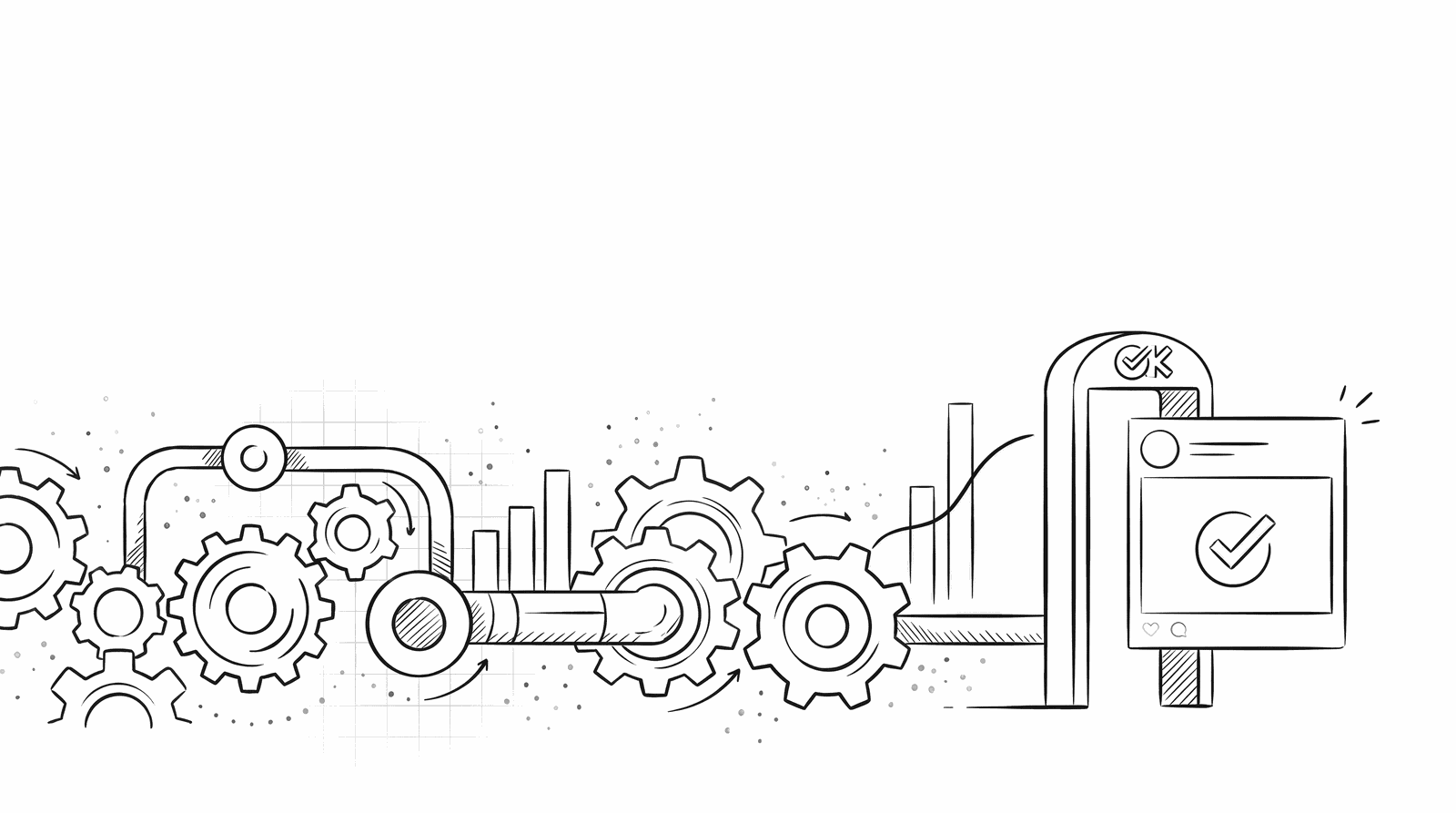
Automation is a pipeline; slop is a pipeline with no human at the end
Automating social media with AI means handing the mechanical work to a machine: drafting, reformatting one idea across platforms, filling the queue. Slop is the failure mode where that machine’s raw output ships unedited. Same pipeline, opposite result, and the only variable is the human at the end.
Here is the distinction people keep collapsing. “Automation” describes the workflow. “Slop” describes the output quality. You can have a heavily automated workflow that produces excellent posts, and you can have a barely automated workflow that produces garbage. The word that got named 2025 Word of the Year by Merriam-Webster and the American Dialect Society, plus the Economist and Macquarie Dictionary, was not “automation”. It was “slop”, defined as digital content of low quality produced in quantity by AI. Nobody voted against pipelines. They voted against unedited output.
Heinz Marketing put the failure mode precisely: slop is content that is “technically acceptable but emotionally empty, correct, polished, and optimized, yet indistinguishable” from every competitor’s (Heinz Marketing). That is the default state of any language model. Ask it for a LinkedIn post and it returns something grammatically perfect and completely forgettable. The automation did not cause that. The absence of an editor did.
So the goal is not “less automation”. The goal is a pipeline with a gate. Automate the drafting and the reformatting as hard as you want. Just do not connect the last node directly to the publish button.
The market already punishes the unedited version, on purpose
Platforms and audiences have stopped treating mass-produced AI content as neutral. Unedited automation now costs you reach, money, and trust, and that is a deliberate design choice by the people who run the feeds.
YouTube made this explicit. On July 15, 2025, it updated its monetization rules, renaming the “repetitious content” policy to “inauthentic content” and clarifying that mass-produced or templated content, including “AI-generated content made with generic templates” with no original insight, is not eligible to earn (Social Media Today). Read the wording carefully. YouTube did not ban AI. It banned the output of an unsupervised pipeline. Content “easily replicable at scale” with “little to no variation” is the exact thing you get when you wire a model straight to publish.
The audience side is just as clear. Hootsuite’s Social Trends 2026 report found 91 percent of marketers say human involvement is very important or critical when generating or evaluating AI content, and Sprout Social reports consumers want brands to make human-generated content their top priority. Heinz Marketing cites survey data that nearly 90 percent of people say they prefer content made by humans. None of that means “never use AI”. It means the finished thing has to read like a person cared. The tool is invisible. The lack of an editor is not.
I dug into the trust mechanics of this in a companion piece on AI content versus human content in 2026, including the strange finding that people happily read AI writing until the moment they realize it is AI. The short version for automation: the penalty is never for using the pipeline. It is for the seams showing.
Automate the grind, not the judgment
The correct split is boring and it works. Give AI the mechanical work, the drafts, the reformatting, the queue. Keep the judgment work for a human, the voice, the facts, the taste to kill a post that says nothing. The data shows the good teams already operate exactly this way.
The Sociality.io 2026 survey is the clearest picture I found of what marketers actually delegate to AI. Look at where the usage clusters, and where it drops off a cliff.
Ideation, drafting, and reporting are where AI earns its keep. Full “automation and optimization” sits at just 10.8 percent (Sociality.io). Marketers are not handing AI the keys and walking away. They are using it to remove the typing, then staying on the wheel. The same survey found 47.4 percent create more content at faster speeds with AI and 71.1 percent name time savings as the biggest win. That is the real prize: not autopilot, but hours bought back from the grind and spent on the two decisions that actually move an account.
Here is the division of labor I run, and I would defend every line of it:
| Give to the AI pipeline | Keep for a human |
|---|---|
| First drafts of every post | The point of view and the angle |
| Reformatting one idea into six platform-native posts | The one specific number or lived detail |
| Filling the queue on a schedule | The fact-check against a named source |
| Summarizing a long piece into a caption | The final voice, so it is not the default AI tone |
| Turning a rough voice note into structured copy | The taste to kill a post that is technically fine and says nothing |
That last row is the whole job now. “Technically fine and says nothing” is exactly what the model produces by default and exactly what the platforms demote. Automating the drafting is easy. Automating the taste is the thing nobody has managed, which is precisely why the human is not overhead. The human is the moat.
The four safeguards that keep a pipeline clean
A clean AI automation pipeline is not about a better model. It is about four safeguards bolted around the model. Miss any one and the output drifts back toward generic. Keep all four and an agent can run your whole calendar without embarrassing you.
I will be concrete, because “add human oversight” is useless advice without the mechanics.
1. A brand voice file the model reads before every draft. If you do not feed the model your voice, you get the factory tone every single time. This is not a vibe, it is a file: your best twenty posts, your banned words, your sentence rhythm, the things you never say, the things you always say. The businesses that keep their voice while scaling AI, per Sociality.io’s own guidance and every governance framework I read, codify tone and terminology in one place the model consults before it writes. No voice file, no voice. It is that mechanical.
2. A required human approval step before anything public. Drafts are the default. Nothing reaches the feed without a deliberate human yes. You do not have to review every post line by line: a tiered rule works well, where low-risk routine posts get a light look and anything touching product, pricing, or a live news moment gets full scrutiny. The point is that the publish action is never the last node the automation touches on its own.
3. An editing rule that strips the AI tells. This is the step almost everyone skips, and it is why so much “human-reviewed” content still reads like a bot. The tells are specific and detectable: em-dashes and en-dashes, smart quotes, the rule-of-three list, “delve”, “unlock”, “in today’s fast-paced world”, the “it’s not just X, it’s Y” construction. A real edit rule removes them mechanically before a person even reads for meaning. Zero AI artifacts is not a stylistic preference. It is the difference between content that passes as human and content that gets pattern-matched as slop by a reader in half a second.
4. No auto-publish of unreviewed AI output. Ever. This is the one that is non-negotiable, and it is the one “set and forget” automation violates by design. Setting AI to autopilot is how brands post tone-deaf content during a crisis and how the pipeline ships its worst single output straight to your audience with no chance to catch it. The whole value of the first three safeguards evaporates the moment output can reach the public without passing them.
If you want the last-mile edit turned into an actual repeatable process rather than a good intention, that is the exact thing I built the blog-writer agent skill to enforce: it drafts fast, then strips every AI artifact so the output has zero em-dashes, zero smart quotes, and none of the filler that flags a piece as machine-made. The point of the skill is that the artifact-stripping should not depend on you remembering. It should be part of the pipeline.
Automation should scale your judgment, not delete it
The right way to think about an AI pipeline is as an amplifier for a human’s taste, not a substitute for it. Automation that scales your judgment makes every good decision you make apply to a hundred posts. Automation that replaces your judgment just scales the absence of one.
This is the frame I keep coming back to, and it changes how you build the pipeline. If the automation exists to delete the human, you optimize for removing approval steps, and you get slop at volume. If the automation exists to scale the human, you optimize for putting your voice and your standards in front of the machine, then letting it do the mechanical reach. Same tools. Completely different result. The 10.8 percent of marketers doing full automation are mostly discovering the first version. The teams quietly winning are running the second.
This is also the whole reason I built the human checkpoint into PostSider as a default rather than an option. An AI agent can draft your entire calendar, reformat every post per platform, and fill the queue over our agent bridge. But the workflow always routes through a review step where a person sees, edits, and approves before anything publishes, and the same posts are visible in the human dashboard the whole time. The agent brings the speed. The person keeps the voice and the send button. In a feed the whole internet now suspects is half machine, that human checkpoint is not friction. It is the product.
So here is the one line I would put on the wall before turning any AI automation loose on a real account. The scarce thing in 2026 is not content. It is a feed where a person obviously bothered. If your pipeline cannot guarantee that on every post, you have not built automation. You have built a slop machine with a schedule. What is the one post going out this week that would be visibly worse if a human had not touched it, and does your pipeline actually let that human touch it?
Frequently asked questions
What is the difference between AI social media automation and AI slop?
Automation is the pipeline: an AI drafts, reformats per platform, and queues posts on a schedule. Slop is what comes out the end when nobody edits it. The same pipeline produces good work or sludge depending on one thing, whether a human owns the final post before it publishes.
Can I automate social media with AI and still keep a human voice?
Yes, if you give the automation your voice up front and a human at the end. Feed it a brand voice file with real examples, run every draft through an artifact-stripping edit, and never auto-publish anything a person has not approved. Automate the grind, keep the judgment.
Should AI auto-publish social media posts without review?
No. Auto-publishing unreviewed AI content is how brands end up tone-deaf during a crisis and how slop ships with your name on it. The reliable setup keeps drafts as the default and puts a human approval step in front of anything public.
What safeguards stop AI automation from producing generic content?
Four that matter: a brand voice file the model reads before every draft, a required human approval step before publish, an editing rule that strips AI tells like em-dashes and filler, and no auto-publish of unreviewed output. Miss any one and quality drifts toward the default AI tone.
Does AI-generated content hurt your reach in 2026?
Unedited, mass-produced AI content does. YouTube updated its monetization policy in July 2025 to exclude inauthentic, mass-produced content, and audiences disengage the moment they smell the default AI tone. AI-assisted content that a human shaped is treated like any other good post.
How much of AI social media work should be automated?
Automate the mechanical part, the first drafts, the per-platform reformatting, the queue filling. In a 2026 survey by Sociality.io, only 10.8 percent of marketers used AI for full automation, while most used it for drafting and ideation. The pattern is assist heavily, automate the grind, keep the final call human.